
Pool Filter Cleaning in Corona, CA
Pool filter cleaning for cartridge, DE, and sand filters: full teardown, degreaser and acid soak when the water calls for it, inspection, and a pressure check on restart.

Schedule Service!
Expert Pool Filter Cleaning for Corona Pools
Clear water starts at the filter, and Corona is hard on filters.
Your filter works harder in Corona than most people realize. Heat, hard water, spring pollen, and the dust the Santa Ana winds push into every backyard all end up in it. It catches everything that would otherwise cloud the water. When it loads up, the water goes hazy and flow at the returns drops. The pump strains against the pressure and the electric bill creeps up. Chlorine stops keeping up too, because a dirty filter leaves more for it to fight.
A proper pool filter cleaning is more than a hose-off at the equipment pad. We shut the system down, open the tank, and pull the cartridges or grids. We clean them the right way for what is on them, check every part that wears, and put it back together. The pressure gauge tells us it worked. Corona’s calcium-heavy water means a plain rinse often is not enough. Oils and sunscreen bind the dirt, and scale locks it in. The cleaning has to happen in the right order to work.
We clean cartridge, DE, and sand filters on every brand you find on Corona equipment pads. Hayward, Pentair, Jandy, and Zodiac are the usual four. Full Service weekly customers get filter cleaning twice a year as part of the plan. Anyone else can book it as a one-time job. If your pressure gauge is reading high or the water will not clear, call (951) 501-2227 or request a free quote. We will get the filter back to doing its job.
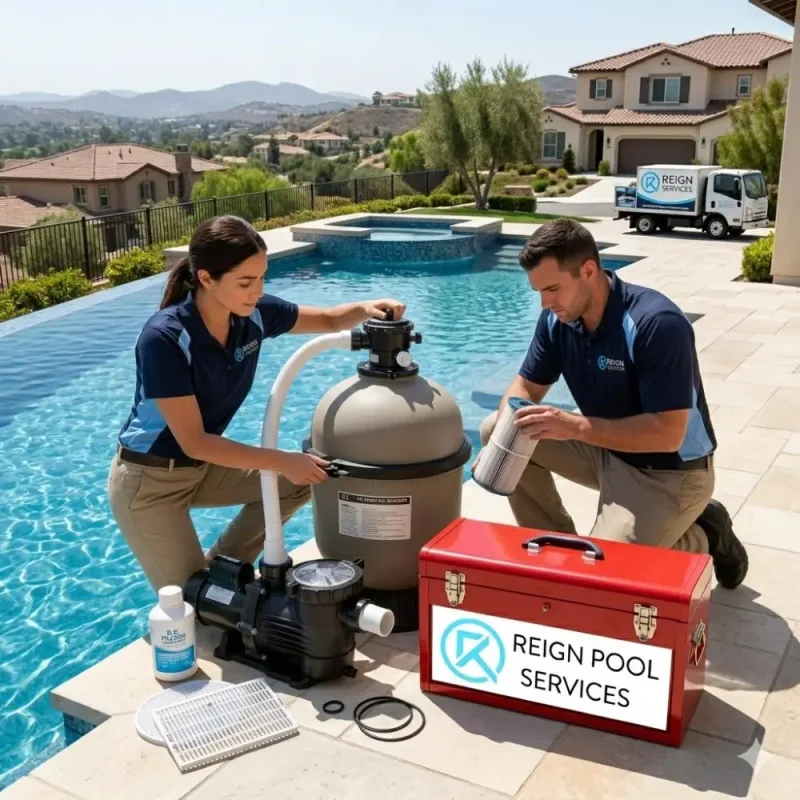
Need a filter cleaning? Schedule your free quote from Reign Pool Services
We Are Experts With:



Pool Filter Cleaning in Corona: Why It Matters Here
A pool filter is the only thing between the water and everything that falls into it. Dirt, pollen, skin oils, sunscreen, algae spores, and the fine dust that settles on every surface in Corona all end up in the filter. As the media loads, the gaps that trap debris get smaller. That is why a filter cleans best right before it is due for a cleaning. Push past that point and flow drops, pressure climbs, and the water starts to cloud.
Three things make Corona pools load a filter faster than the manuals expect. The first is calcium. Hard fill water leaves scale inside the media the same way it leaves a line on the tile, and scale does not rinse off. The second is oils. Hot afternoons mean more swimmers, more sunscreen, and more body oil. Oil coats cartridge pleats and DE grids so dirt sticks to them. The third is wind. One Santa Ana event drops a season’s worth of grit into the pool in a night, and all of it goes through the filter.
Without routine filter cleaning the chemistry gets harder to hold, algae gets a foothold, and the pump works against a wall. A pump pushing through a clogged filter runs hotter and wears seals faster. That is how a cleaning you skipped turns into a pool pump repair you did not plan for.
Types of Pool Filters We Clean
Each filter type traps dirt differently, so each one gets cleaned differently. The pressure gauge is the common language across all three.
Cartridge filter cleaning
Cartridge filters are the most common type on newer Corona pools and on almost every spa. The pleated element catches particles down to roughly 10 to 25 microns and is not backwashed. Instead the element comes out of the tank for cleaning. We hose each pleat from the top down. Then the cartridge soaks in a filter cleaner that lifts oils and sunscreen. After a full rinse, and only then, we use a mild acid soak if calcium is still on the pleats. The order matters. Acid on an oily cartridge sets the oil into the fabric and the cartridge never flows right again. Cartridges are more sensitive to high flow than any other media. A pump pushing too hard drives dirt deep into the pleats where cleaning cannot reach it.
DE filter cleaning
DE filters polish water finer than anything else on a residential pad, down to a few microns. The grids wear a coat of diatomaceous earth, and the powder does the actual filtering. Backwashing knocks the dirty cake off the grids, but it never gets all of it. Over time oils and calcium build up on the grid fabric. A full DE filter cleaning means pulling the grid assembly and hosing every grid. We check the fabric for tears, soak in degreaser, soak in acid if there is scale, reassemble, and recharge with fresh DE through the skimmer. We measure the charge rather than guess it. Too little powder and oils clog the fabric. Too much and the cake bridges between grids. On a residential pool we open DE filters for a full grid cleaning about every three months of run time. A heavy pollen spring moves that up.
Sand filter cleaning
Sand filters clean themselves by backwashing, so most weeks they need nothing but a pressure check. The water flows in reverse, lifts the sand bed, and carries the trapped dirt to waste until the sight glass runs clear. Backwashing on a calendar instead of on pressure is a common mistake. Sand filters trap the smallest particles only when the bed has loaded up a bit. Backwashing too often leaves the water less clear, not more. Over years the sharp edges on new sand wear smooth and the bed starts channeling. That is when a sand change is due. We also check the laterals and the multiport valve while the tank is open. A cracked lateral puts sand in the pool and a worn valve wastes water.
What Our Pool Filter Cleaning Service Includes
This is a complete cleaning and inspection, not a quick rinse at the pad.
Shutdown and full disassembly
We shut the pump off, relieve the pressure, and open the tank. Then we remove every internal part: cartridges, grid assemblies and manifolds, or the sand filter’s valve and laterals as needed.
Cleaning in the right order
We hose each cartridge or grid from top to bottom to remove loose dirt. Then it soaks in a filter cleaner that dissolves oils and sunscreen. After a full rinse, any calcium left on the media gets a light acid soak. We never skip the degreaser, and we never run acid first.
Inspection of the parts that fail
We check cartridge end caps and pleat bands, DE grid fabric and manifolds, sand filter laterals, the tank O-ring, and the pressure gauge and air relief. We lubricate or replace a worn O-ring so the tank does not leak or pull air after reassembly.
Reassembly and DE recharge
Everything goes back in seated correctly and we close the tank. On a DE filter we add the fresh charge of powder through the skimmer with the pump running, so it coats the grids evenly.
Startup and pressure check
We restart the system, bleed the air, and record the clean starting pressure. That number is the baseline for the next cleaning. If the pressure after cleaning still sits well above the original clean reading, the media is past saving. We tell you so.
What the Pressure Gauge Is Telling You
The gauge on top of the filter is the most useful instrument on the pad, and most owners never look at it. Every filter has a clean starting pressure, the reading right after a cleaning with the pump at its normal speed. On most Corona pads that lands somewhere between 8 and 15 psi, and the exact number matters less than the change from it.
As dirt loads the media, pressure climbs and flow drops. A rise of 8 to 10 psi over the clean reading means the filter needs cleaning or backwashing. A reading that sits high the day after a cleaning means the media is worn out, or the cleaning missed the oils underneath the dirt. A reading that is lower than normal usually means air in the system or a pump problem, not a clean filter. We write the clean pressure on the tank after every service so the next person who looks at it has a number to compare against.
On a variable-speed pump the gauge reads differently at each speed, so always compare readings taken at the same speed. A filter that shows 12 psi at low speed and 25 at high speed is not dirty. It is doing exactly what the physics says it should.
Filter Cleaning and Corona's Hard Water
Calcium is the part of filter cleaning that is specific to this area. Corona’s fill water carries enough calcium that every gallon through the filter leaves a little behind, on cartridge pleats, on DE grid fabric, and in the gaps between sand grains. Scale does not rinse off and it does not degrease off. It takes a mild acid soak, and the acid only works once the oils are gone.
Keeping calcium hardness and pH in range during weekly service slows scale down, which is why the same crew doing the chemistry and the filter cleaning works better than two companies doing one each. When we open a filter and find heavy scale, we also look at the heater and the salt cell, because the same water has been running through those. A scaled cartridge is often the first warning that the rest of the pad is scaling too. The CDC’s healthy swimming guidance covers the water balance ranges we hold.
How Often Should a Pool Filter Be Cleaned in Corona?
For most Corona pools, a full cleaning every three to six months is right. Filter type, pool use, tree cover and pollen, wind events, and whether the pool has a cover all move the interval. Spring pollen and fall winds are the two heavy seasons. A cleaning after each one keeps most pools out of trouble.
The pressure gauge gives a better answer than the calendar. Note the clean starting pressure after a cleaning. When the gauge reads 8 to 10 psi above that number, the filter is due, whatever the date says. On a system with gauges on both sides of the filter, a 10 to 20 psi difference between them means the same thing.
If you wait until the water clouds or the returns go weak, the filter has been overloaded for a while. The pump has been paying for it.
Signs Your Pool Filter Needs Cleaning
Pressure 8 to 10 psi above the clean reading is the first sign and the most reliable one. After that: cloudy water that chemicals do not fix, weak flow at the returns, and a cleaner moving slowly or not at all. Debris or DE powder blowing back into the pool, chlorine that will not hold, and air bubbles or surging at the pump round out the list. Neighborhoods with heavy landscaping, mature trees, or open ground to the east see these sooner.
Cleaning or Replacing the Filter Media
Cleaning restores a filter when the media is intact. It cannot restore media that is worn out. A cartridge whose pleats stay gray after a full soak is done. So is one with frayed bands, a cracked end cap, or pressure that climbs back within weeks. A new cartridge costs less than cleaning it twice more. Torn DE grids put powder in the pool, so we replace them. Sand that channels or will not clear after backwashing needs changing, usually every three to five years. We tell you which you are looking at before the work starts. If it is time for a new tank, we handle the pool filter installation.
Why Corona Homeowners Choose Reign for Filter Cleaning
Based in Corona, we know what local water does to a filter and we clean for it. Every cleaning is a full teardown with the parts inspected and the starting pressure recorded. Weekly customers on the Full Service plan get it twice a year without asking. One-time customers get a straight answer on whether the filter needs cleaning, replacement, or nothing yet. Call (951) 501-2227 or request a free quote.
Pool Filter Cleaning in Corona: Frequently Asked Questions
Quick answers from the crew.
Cost, timing, and what is included
Full Service weekly customers get filter cleaning twice a year as part of the plan. As a one-time job we quote by filter type, since a DE grid teardown takes longer than a cartridge. You get the price before we open the tank.
Every three to six months for most Corona pools, after the spring pollen and after the fall winds. The gauge is the better guide. When pressure reads 8 to 10 psi above the clean starting pressure, the filter is due.
Both the Full Service and Chemical Only plans include filter cleaning twice a year. Backwashing a sand or DE filter when the pressure calls for it is part of the regular visit. We quote extra cleanings after a wind event or a green pool separately.
Shutdown, full disassembly, and hosing. A degreaser soak, then an acid soak if there is calcium. Inspection of grids, cartridges, laterals, and O-rings. Reassembly, a DE recharge where needed, and a restart with the clean pressure recorded.
Usually under an hour for a cartridge filter and longer for a DE grid teardown, plus soak time. The pool is back in service as soon as we restart and bleed the system.
Filter types and hard water
Usually. A mild acid soak dissolves calcium scale, but only after a degreaser has removed the oils. Acid on an oily cartridge locks the oil in. If the pleats stay stiff and gray after both soaks, the cartridge is done.
Yes. The grids come out and we hose them and check for tears. They soak in degreaser, and in acid if needed, and go back in. Then we add a measured charge of fresh DE through the skimmer so the grids coat evenly.
Backwashing handles routine cleaning, and it should follow the pressure gauge, not a schedule. We open the tank to check the laterals and valve. We change the sand when it channels or will not clear, usually every three to five years.
When the gauge reads 8 to 10 psi above the clean starting pressure recorded after the last cleaning. With a gauge on each side of the filter, a 10 to 20 psi difference means the same thing.
If the filter is the cause, yes, and high pressure with cloudy water usually means it is. If pressure is normal and the water is still cloudy, the problem is chemistry, a torn grid, or a pump issue. We check for those before recommending a cleaning.