
Spa Repair in Corona, CA
Spa repair for attached pool spas and portable hot tubs: heaters that will not warm up, weak jets, humming pumps, leaks, tripping GFCIs, and error codes on the panel.

Schedule Service!
Expert Spa and Hot Tub Repair for Corona Homeowners
A spa that is cold, quiet, or sitting in a puddle is a short list of parts. We know which one it is.
A spa breaks differently than a pool. It runs hot all the time and holds a few hundred gallons instead of twenty thousand. It packs a pump, a heater, a blower, a control pack, and a dozen jets into a cabinet the size of a closet. When one part fails it usually takes a second one with it. A scaled heater element trips the GFCI. A leaking pump seal drips onto the control pack. A clogged filter starves the heater and the panel throws a flow code. So spa repair means reading the chain of events rather than swapping the part that looks dead.
Corona makes the chain run faster. The fill water is heavy with calcium, and calcium drops out of hot water onto the hottest surface it can find. In a spa that is the heater element and the inside of the jets. The sun bakes the cabinet and the cover, and the Santa Ana winds load a small spa filter in weeks.
Our spa repair and hot tub repair service covers both kinds of spa. Attached spas share equipment with the pool, so most of their faults live in the valves and the automation. Portable hot tubs have their own pack, and we work on the common brands. Either way we diagnose first, quote before any work, and say plainly when a part is not worth fixing. Call (951) 501-2227 or request a free quote.
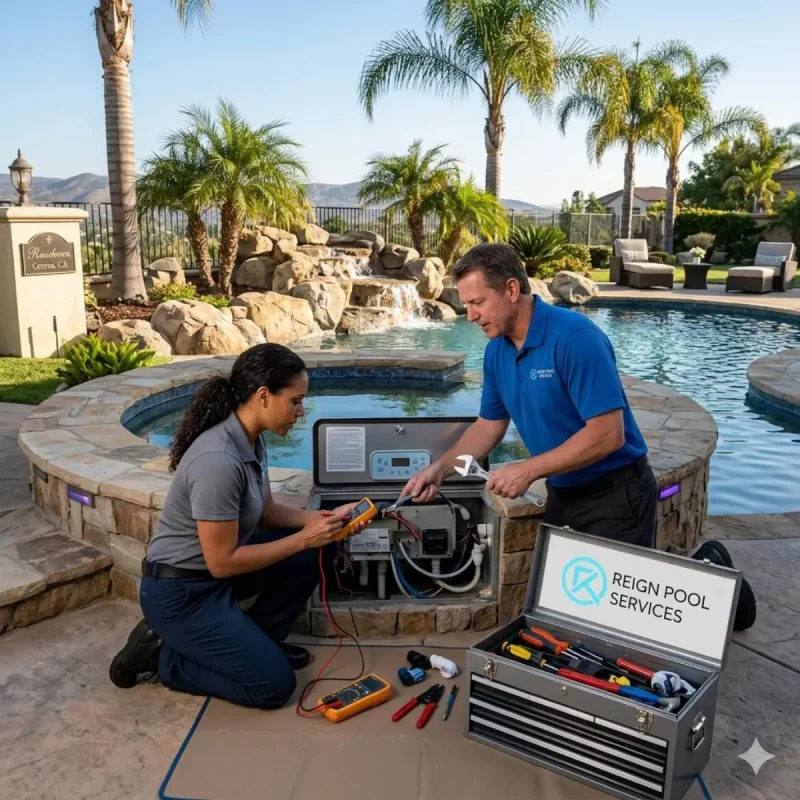
Need spa repair? Schedule your free quote from Reign Pool Services
We Are Experts With:




Spa Repair in Corona: Reading the Symptoms
Most spa calls come in as one of six complaints. Each one points to a short list of parts. The order we check them in is what keeps the bill down.
Spa not heating
The heater is the last thing we blame. On a portable hot tub the control pack will not power the heater until the flow switch or pressure switch proves water is moving. So a dirty filter, a low water level, an air lock, or a closed valve all show up as a cold spa. Once flow checks out, we test the element, the high-limit and temperature sensors, the thermostat, and the heater relay on the board. An attached spa heats through the main pool heater. So a cold spa there is just as often a valve that did not turn, or an automation setting, as a heater fault. If it is the gas heater itself, our pool heater repair page covers what we check.
Jets weak, pulsing, or dead
Weak jets are a flow problem. A clogged filter, a low water level, a closed diverter, an air lock after a refill, or scale narrowing the jet bodies will all do it. Jets that pulse usually mean the pump is cavitating because it cannot get enough water. A single dead jet is a jammed or worn nozzle. If every jet is weak and the filter is clean, the pump impeller is wearing or packed with debris, which is the same fault we chase on pool pump repair calls. On spas with an air blower, no bubbles usually means the blower motor or its check valve.
Pump humming or not starting
A spa pump that hums and does nothing has power but cannot turn. On a single-speed or two-speed pump that is a failed start capacitor or seized bearings. We turn the shaft by hand to tell them apart. A pump that runs but moves no water has an air lock or a jammed impeller. A pump that grinds has bearings going out, usually because the shaft seal leaked water into the motor first.
Leaks under the cabinet
Spa leaks come from the pump seal, the heater unions, the manifold and jet bodies, the slice valves, or a crack in a PVC fitting. We find them by looking first, then by isolating lines and dye testing. A pump seal leak is the common one in Corona because scale wears the seal faces. We fix it before the water reaches the bearings or the control pack sitting next to it.
GFCI tripping
A spa that trips the GFCI is telling you current is leaking to ground. That is a safety issue first. The heater element is the usual source, because a scaled or corroded element cracks its sheath and lets water reach the coil. The pump motor, the blower, the ozonator, and wet wiring are next in line. We isolate each one until the trip stops rather than resetting it over and over. Never bypass a GFCI.
Error codes on the panel
FLO or FL means the pack cannot prove water flow through the heater. OH means the water or the heater housing is too hot. DR or DRY means the heater thinks it is running without water. SN codes mean a sensor is open or shorted. Most of these trace back to flow. So we clean the filter, check the water level, and clear any air lock before we touch a sensor or a board.
What Our Spa Repair Service Includes
Pumps and blowers
Capacitors, bearings, shaft seals, wet ends, impellers, and full pump swaps on jet pumps and circulation pumps. Blower motors and check valves. A replacement pump has to match the frame, the voltage, and the plumbing of the original, or the jets never feel right again.
Heaters and elements
Heater elements, flow and pressure switches, high-limit and temperature sensors, and heater assemblies on portable spas. On pool and spa combos, the valves, actuators, and automation settings that route heat to the spa.
Jets, plumbing, and leaks
Jet nozzles and bodies, diverter valves, air controls, manifolds, unions, and the PVC between them. Leak isolation and repair, with the cabinet closed back up dry.
Control packs and topside panels
Boards, relays, transformers, sensors, and topside controls. We test the chain before we condemn a board, because a bad sensor is cheap and a bad board is not.
Electrical and GFCI
Ground-fault isolation, wiring, disconnects, and bonding checks. We find which component is leaking current and fix that, rather than replacing the breaker and hoping.
Test and set
After the repair we refill if needed, bleed the air, and run every jet and the blower. We confirm the heater brings the water to set point and holds it, and we check that the GFCI holds under full load. Then we test the water, because a spa that was down for a week is out of balance.
Why Corona's Hard Water Is Hard on Spas
Calcium becomes less soluble as water gets hotter, and a spa is the hottest water on the property. So scale forms on the heater element first, then inside the jets and the small plumbing. A scaled element heats slower, runs hotter under the crust, and eventually cracks. Scale narrowing the jet bodies is why jets get weaker every season even with a clean filter. The same chemistry that scales the hardware also corrodes it when it swings the other way. Spa water swings fast because there is so little of it.
Water balance is the repair that prevents the other repairs. Holding pH, alkalinity, and calcium hardness in range, draining on a schedule, and keeping the filter clean are most of what keeps a spa out of our truck. Our spa cleaning service handles that side, and the CDC’s hot tub guidance covers the ranges we hold. Rising dissolved solids as the water ages also push galvanic corrosion on the heater and staining on the shell. That is one more reason the drain interval matters.
Attached Pool Spas and Portable Hot Tubs
An attached spa shares the pool’s pump, filter, and heater. Its problems are mostly about routing. The suction and return valves, the actuators that turn them, the spillover setting, and the automation that runs the sequence. A spa that fills slowly, overflows, or will not warm up while the pool heats fine is almost always a valve or a setting. We work on Pentair, Hayward, and Jandy automation and valve systems.
A portable hot tub has its own pack. Pump, heater, blower, board, and topside all live in the cabinet, and the shell and the cover are part of the system too. We service the common brands and the standard packs they use. If a portable spa needs a part the manufacturer no longer makes, we tell you. Then we talk through whether a universal pack or a new tub makes more sense.
Repair the Spa or Replace It?
Repair it when the fault is one part and the spa has years left: an element, a capacitor, a seal, a sensor, a jet, a topside. Replace the component when it has failed twice, when the pump or heater is at the end of its life, or when the parts are no longer supported. Replace the spa when the shell is cracked, the cabinet and base are rotted from a long leak, or the repair list adds up to most of a new tub. We give you the numbers side by side.
Keeping the Spa Out of the Repair Queue
Three habits prevent most of the calls we get. Keep the water level above the skimmer or the suction fittings so the pump never runs dry. Clean the cartridge every week or two and deep clean it on a schedule, because a loaded filter triggers heater shutdowns and weak jets. And keep the chemistry balanced so the element and the jets do not scale. A spa on a regular cleaning schedule with the drains done on time rarely needs us for anything bigger than a seal.
Spa Leak Repair
A spa that needs topping off every few days has a leak, and the water bill is the least of it. Water running under the cabinet rots the base, shorts the control pack, and pulls dirt into the plumbing. On a portable spa we pull the panels, dry the floor, and run the pump while watching the unions, the heater fittings, the manifolds, and the jet bodies. Slice valves and glued PVC joints crack with age and heat. On an attached spa a slow drop in the spa level with the pool holding steady points to the spa’s own plumbing or a check valve, and we isolate the lines to prove it. Most spa leaks are a fitting or a seal, not the shell, and we repair them in place.
How a Spa Repair Call Works
Call or send the form with what the spa is doing and the code on the panel if there is one. We come out, check flow and water level first, then test the parts in order and give you the price before any work. Most repairs finish on the first visit when the part is one we carry. You do not need to be home if we can reach the spa and the disconnect.
Why Corona Homeowners Call Reign for Spa Repair
We are based in Corona and we service spas that run on the same hard water as our own. Every call starts with flow and water level before we blame any part. Every GFCI trip gets isolated to its source. And you hear repair and replacement side by side. Call (951) 501-2227 or request a free quote.
Spa Repair in Corona: Frequently Asked Questions
Quick answers from the crew.
Cost, lifespan, and repair vs. replace
It depends on the part. A capacitor, a sensor, a jet, or a topside panel is a small job. A pump, a heater assembly, or a control board is a mid-sized one. A new pack or a shell repair is the largest. We diagnose first and give you the price before any work starts.
Usually. Pumps, heaters, boards, sensors, and jets are all serviceable, and most faults are one part. It stops being worth it when the shell has cracked, a long leak has rotted the base, or the parts are no longer made. We tell you which before we quote.
Jet pumps and heater elements run roughly five to ten years. Corona's hard water sits at the short end for heaters, because scale cracks elements early. Control packs often last longer if they stay dry.
Yes, both. Attached spa faults are mostly valves, actuators, and automation on Pentair, Hayward, and Jandy systems. Portable hot tubs get their own pump, heater, blower, board, and topside diagnosis.
Tell us the symptom and any panel code when you call. We check flow and water level first, carry common parts, and finish most repairs on the first visit.
Symptoms and causes
Check the filter, water level, and valves first, because the pack will not power the heater without proof of flow. After that it is the element, a sensor, the high limit, or the heater relay. On an attached spa it is often a valve or an automation setting rather than the heater.
Low flow. A dirty filter, low water, a closed diverter, an air lock, or scale inside the jet bodies. If the filter is clean and every jet is weak, the pump impeller is worn or packed with debris. One dead jet is a nozzle.
It has power but cannot spin. On most spa pumps that is a failed start capacitor or seized bearings, and we turn the shaft by hand to tell them apart. A pump that runs but does not move water has an air lock or a jammed impeller.
Current is leaking to ground, most often through a scaled or cracked heater element. The pump motor, blower, ozonator, and wet wiring are next. We isolate the source rather than resetting the breaker. Never bypass a GFCI.
FLO means the pack cannot prove flow through the heater. OH means the water or heater is overheating. DR means the heater thinks it is dry. All three usually trace to a dirty filter, low water, or an air lock, so we check those before any sensor or board.