
Pool Automation in Corona, CA
Pool automation installation and repair: Pentair, Hayward, and Jandy control systems that run your pump, heater, lights, valves, and salt cell from one app, installed on the equipment you already own.

Schedule Service!
Expert Pool Automation Installation and Repair for Corona Pools
Your pool should run itself. In Corona it can, from the couch or from the office.
A pool in Corona runs eight or nine months a year. Every one of those days somebody has to think about the pump schedule, the heater, the lights, and whether the spa is warm before guests show up. Most of that happens at the equipment pad with a flashlight. Pool automation moves all of it to your phone. The pump runs its schedule on its own. Your spa heats on the drive home. Lights come on at dusk and go off at midnight. The salt cell adjusts to the season without a trip outside.
The benefit goes past convenience. A variable-speed pump on an automation schedule runs slow for filtration and fast only for the cleaner or the spa. That is where the energy savings come from. The heater fires only when the pump is proving flow. The chemical feeder stops when the pump stops. Everything on the pad works as one system instead of five boxes with five timers, and that is better for the equipment and for the water.
We install Pentair, Hayward, and Jandy pool automation systems on new and existing pads. We retrofit older panels, add actuators and sensors, connect mixed-brand equipment, and repair automation that has stopped talking to its app. Call (951) 501-2227 or request a free quote.
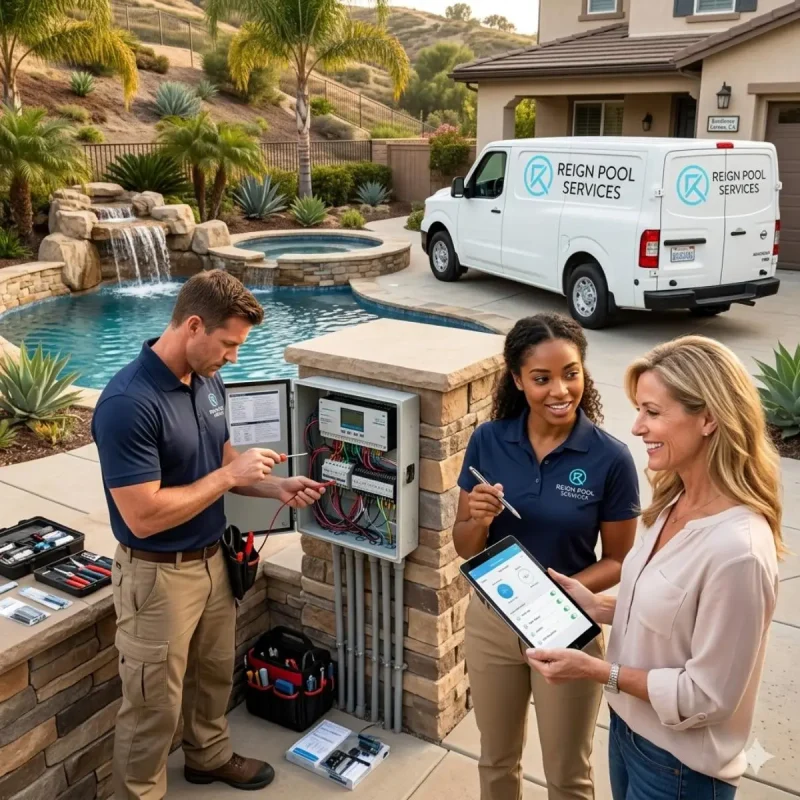
Want your pool on your phone? Schedule your free pool automation quote from Reign Pool Services
We Are Experts With:




Pool Automation in Corona: What a System Controls
A pool automation system is a control panel on the equipment pad, usually built into a load center with its own breakers, that switches and schedules everything plumbed and wired into it. You talk to it through a touchscreen, a wireless remote, or an app on your phone.
Pump and filtration
The automation runs your variable-speed pump through a daily schedule. Low speed for filtration, higher speed for the cleaner, full speed for spa jets. A pool that turns over properly at low speed uses a fraction of the power of the old single-speed timer setup.
Heater and spa
The system holds separate set points for the pool and the spa and only calls the heater when the pump is running and the valves are set. Spa mode turns the valves, ramps the pump, and starts the heater with one tap.
Lights and water features
Pool and spa lights, color shows, waterfalls, bubblers, and deck jets each get a schedule or a one-touch button. Color lights sync across the pool and spa when the brands match.
Salt cell and chemistry
The panel sets the salt cell output and reads its status. Add a pH and ORP module and the system doses acid and adjusts chlorine automatically, with alarms when readings drift or probes need cleaning.
Pool Automation Systems We Install
Pentair
IntelliCenter is the full-pad system for pools with a spa, water features, and multiple lights. IntelliConnect covers a simple pool with a pump, a light, and a salt cell at a lower price. Both pair with Pentair variable-speed pumps, IntelliBrite lights, and IntelliChlor cells.
Hayward
OmniLogic and OmniHub run Hayward equipment and work well with voice assistants. The OmniHub is the retrofit option that adds app control to an existing pad without replacing the load center.
Jandy
iAquaLink controls Jandy pumps, heaters, and WaterColors lights, and it is the natural upgrade for a pad already built around an AquaLink panel. Many Corona pools from the 2000s have one of these.
Mixed brands
Most Corona pads have a mix. A Pentair pump, a Jandy heater, a Hayward salt cell. Any of the three systems can switch a relay for a dumb load, so a mixed pad is not a problem for basic control. Full two-way communication, like reading a heater’s error code or setting pump speeds by RPM, works best when the brands match. We tell you at the quote which of your equipment will talk and which will only switch.
Adding Pool Automation to an Existing Pool
Nearly every system we install goes on a pad that already has equipment. Here is what that involves.
The load center
Automation panels usually replace the existing breaker subpanel at the pad. The pump, heater, light, and cell then land on breakers inside the automation enclosure. If your pad has a tired subpanel with no spare slots, the automation install fixes two problems at once. If your pad feeds from a panel in the garage, we check the feeder size and may add a conduit run.
Valve actuators
To switch between pool and spa, the system needs motorized actuators on the suction and return valves. Most pads have manual Jandy valves that accept an actuator with four screws. Older valves may need replacing.
Sensors and communication cable
A water temperature sensor goes in the plumbing, an air sensor on the pad, and a solar sensor if you have panels. Variable-speed pumps, heaters, and salt cells connect by RS-485 cable. That lets the panel read them as well as power them.
Wi-Fi at the pad
The panel needs a signal at the equipment pad, which is often behind the garage or along a side yard. We test the signal before install and add an outdoor access point or a mesh node when it is weak. Schedules keep running from the panel if the internet drops. Only the app loses contact.
Pool Automation Repair in Corona
Automation that has stopped working is more often a small part than a dead panel. The app will not connect because the router changed. A valve actuator stripped its gears and the spa never fills. One stuck relay keeps the light on all night. Or a pump lost communication because a wire corroded at the pad. Flow switches, temperature sensors, and transformers fail too. We diagnose at the panel with the brand’s service menu, carry common relays and actuators, and quote a panel replacement only when the board itself has failed. A ten-year-old EasyTouch or AquaLink is usually worth repairing. A panel that no longer gets app support is a conversation about upgrading.
Energy Savings From a Variable-Speed Pump on Automation
The pump is the largest electrical load in the yard, and the math works in your favor. Cutting pump speed in half cuts power draw by roughly seven eighths. A pump that filters at 1,500 RPM for twelve hours costs less than one running full speed for four. California requires variable-speed pumps on most residential pools under its Title 20 appliance standards, so a new pump installation already brings the right motor. Automation is what lets you run it the right way. Low filtration speed all day, a short high-speed window for the cleaner, and spa speed only when the spa is on. Owners in Corona typically see the savings on the first summer bill.
Scheduling for Corona's Seasons
A schedule that fits July does not fit January. In summer the pool needs a full turnover every day and the cleaner needs its hour, so the pump runs longer and the salt cell runs higher. In winter the water is cold, nobody swims, and the pump can drop to a few hours of slow filtration. We program two or three seasonal schedules into the panel at install. You switch between them with a tap, or the system does it on a date. Freeze protection is built in too. When the air sensor reads near freezing, the pump turns on to keep water moving through the pipes and the heater.
Safety Built Into the System
Automation adds interlocks that a timer never had. The heater only fires when the pump is running and flow is proven, which protects the heat exchanger. The chemical feeder and salt cell only run when water is moving, so acid and chlorine never collect in a dead pipe. Spa temperature caps at 104 degrees. If a sensor fails or flow drops, the panel raises an alarm in the app instead of letting the equipment run blind. The panel also keeps the low-voltage controls separate from the line-voltage breakers, so the touchscreen and remotes are safe to use with wet hands.
Solar and Heat Pump Control
Many Corona roofs carry solar pool panels, and automation runs them well. A roof sensor compares panel temperature to water temperature and opens the solar valve only when the roof is hotter than the pool. On cool nights the same logic can run water through the panels to cool an overheated pool in August. Heat pumps and gas heaters can share a set point with solar as the first choice and gas as the backup, so you pay for gas only when the sun has not done the job.
Chemical Automation: Worth It or Not?
ORP and pH control systems read the water constantly and dose acid or adjust chlorine to hold a set point. They are standard on commercial pools, and they work on residential pools too, with two cautions. ORP measures oxidizing power rather than chlorine itself, so stabilizer and dirt skew the reading. Probes also need regular calibration and cleaning. For a salt pool in Corona, where pH climbs weekly, an automatic acid feeder paired with the cell is the single most useful addition. For most other pools, weekly pool service with a tech testing the water does the same job without probes to maintain.
Pool and Spa Combo Control
Combos are where automation earns its keep. Spa mode turns both actuators and brings the pump up to jet speed. It lights the heater to the spa set point and switches the spa light on. When you are done, the system drains the spa back to pool mode and resumes the filtration schedule. We set a spillover schedule so the spa stays fresh. The heater never fires on the whole pool when you only wanted the spa.
Smart Home and Voice Control
Pentair, Hayward, and Jandy apps run on iPhone and Android. Hayward’s Omni line and Pentair’s IntelliCenter connect to Alexa and Google Home for voice commands. If you want the pool lights on a scene with the patio lights, we set that up and show you how it works before we leave.
How a Pool Automation Installation Works
Call or send the form with a photo of your equipment pad. We identify what you have, check the pad electrical and the Wi-Fi signal, and quote the system that fits your pad. Most installations finish in a day. We mount the panel, land the breakers, and add actuators and sensors. Then we connect the equipment, program the schedules, and set up the app on your phone. Before we go, we walk you through it.
Why Corona Homeowners Choose Reign for Pool Automation
We are based in Corona and we program systems around how Corona pools actually run: long seasons, hard water, hot pads, and spas that get used most in winter. Every install gets a tested Wi-Fi signal, sensors in the right places, and a variable-speed schedule set for turnover. The app is working on your phone before we leave. We repair before we replace. Call (951) 501-2227 or request a free quote.
Pool Automation in Corona: Frequently Asked Questions
Quick answers from the crew.
Systems, cost, and compatibility
A control panel on the equipment pad that schedules and switches your pump, heater, lights, valves, and salt cell. You run it from a touchscreen or a phone app. It replaces the old mechanical timers and manual valves.
The one that matches the equipment on your pad. Pentair IntelliCenter for a full pad with Pentair gear, Hayward OmniLogic for Hayward pads and voice control, Jandy iAquaLink for pools built around Jandy. For a simple pool, Pentair IntelliConnect or Hayward OmniHub cost less.
It depends on the system, how many actuators and sensors the pad needs, and whether the load center or feeder has to change. The panel is only part of the price. We quote the installed job after seeing your pad.
Yes. Nearly every system we install goes on an existing pad. We replace the subpanel with the automation load center and add actuators to the valves. Then we connect the pump, heater, and cell and set up the app. Most installs take a day.
For basic on and off control, yes. Any panel can switch a relay for any brand. Two-way features like reading a heater's error code or setting pump RPM work best when the brands match. We tell you which of your equipment will fully communicate.
Wi-Fi, savings, and repairs
Usually a Wi-Fi change at the house, a weak signal at the pad, or a cloud account that needs re-linking. Less often a failed wireless bridge. The panel keeps running schedules without the app. We check the signal and the bridge first.
The savings come from running a variable-speed pump slow for filtration. Half the speed uses about an eighth of the power. Automation is what sets and holds that schedule and keeps the heater from firing when the pump is off.
Yes, and this is where it shines. Spa mode turns the valves, ramps the pump, and heats to the spa set point with one tap. It returns to pool mode on its own.
Repair it when the fault is a relay, actuator, sensor, or communication issue, which is most of the time. Replace it when the board has failed or the system no longer has app support. We diagnose at the panel before quoting either.
For salt pools in Corona, an automatic acid feeder is the most useful add-on. The cell pushes pH up every week. Full ORP and pH control works but needs probe cleaning and calibration. For most pools, a weekly service tech testing by hand does the same job.