
Pool Salt Systems in Corona, CA
Pool salt system installation, salt water pool conversion, salt cell replacement, and repair: Pentair, Hayward, and Jandy chlorine generators sized to your pool and set up for Corona’s hard water.

Schedule Service!
Expert Pool Salt System Installation and Salt Cell Replacement for Corona Pools
Softer water, chlorine made on the pad, and no more jugs in the trunk.
A salt water pool is still a chlorine pool. The difference is where the chlorine comes from. A salt cell on the equipment pad passes low-voltage current through mildly salty water and turns the salt into chlorine as the pump runs. The chlorine sanitizes the pool, then turns back into salt, and the cycle repeats. The water carries about a tenth of the salt in the ocean, less than a teardrop, and most people notice only that it feels softer and does not sting their eyes.
Corona homeowners switch to salt for the steady chlorine. A cell running on a schedule holds sanitizer through a 105 degree week in a way a floating tab feeder never does. The trade is that Corona is hard on salt cells. Our fill water is loaded with calcium, and a salt cell is where that calcium likes to land. The cell makes the pH drift upward too. A pool salt system in Corona needs to be sized right, installed with a flow switch and the right wiring, and kept clean. Set up well, it runs for years. Set up poorly, it scales up in a season and the pool turns green.
We install new salt systems, convert chlorine pools to salt, replace worn-out salt cells, and repair systems that have stopped producing. We work on Pentair IntelliChlor, Hayward AquaRite and TurboCell, and Jandy AquaPure and TruClear. Call (951) 501-2227 or request a free quote.
Thinking about salt? Schedule your free pool salt system quote from Reign Pool Services
We Are Experts With:




Pool Salt System in Corona: How a Salt Water Pool Works
A salt chlorine generator has two parts. A control box mounted on the pad and a cell plumbed into the return line after the filter and heater. Inside the cell are titanium plates. When water flows and the pump is running, the box sends current across the plates and the dissolved salt in the water splits into chlorine gas and sodium hydroxide. The chlorine dissolves into the water as it leaves the cell and does the same job as the chlorine from a jug.
Salt level
The pool runs at roughly 3,000 to 3,500 parts per million of salt, depending on the brand. Salt is not used up. It leaves only with splash-out, backwash, and the water you drain, so a few bags a year keeps it in range once the pool is loaded.
Output and run time
The cell only makes chlorine while the pump runs. Output is set as a percentage. In a Corona summer a mid-size pool often runs the cell at 60 to 80 percent for eight to ten hours a day. In winter it drops to 20 percent and a few hours, and most cells stop producing below about 50 to 55 degrees water temperature.
Self-cleaning and the flow switch
The control box reverses the current on a schedule to shed calcium from the plates. A flow switch shuts the cell off when the pump stops, so chlorine gas never collects in a dead pipe. Both matter more in Corona than almost anywhere, because our calcium levels test the self-cleaning cycle and our pumps run long.
Salt Water Pool Conversion in Corona
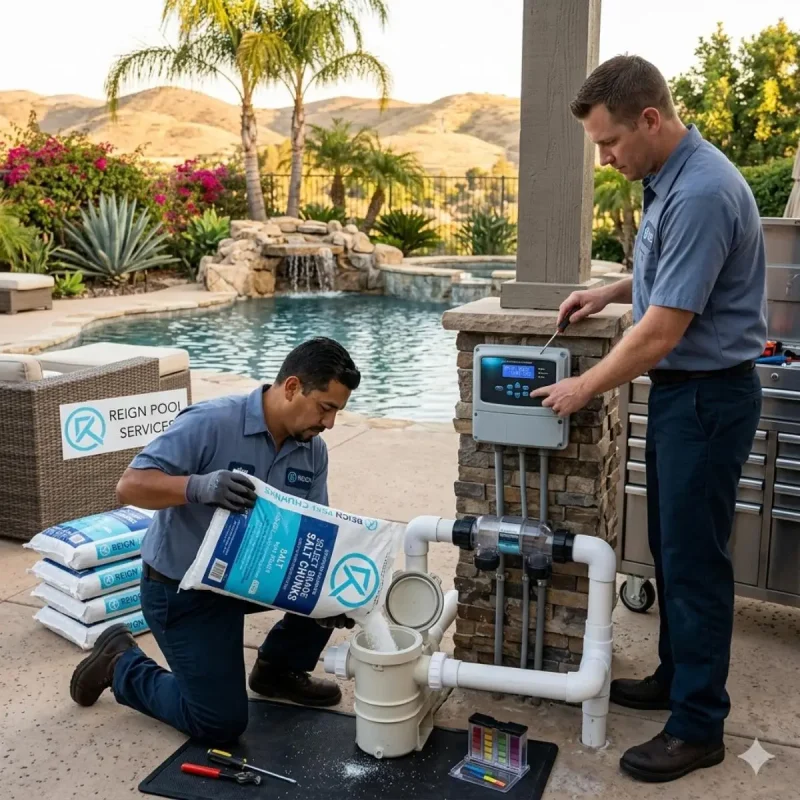
Converting a chlorine pool to salt is a one-day job on most pads. We plumb the cell into the return line after the heater, mount the control box, wire it to the pump circuit or the automation so it only runs with the pump, and install the flow switch. Then we add salt to the pool, let it dissolve for a day, balance the water, and set the output. Nothing changes about the pool itself. The plaster, the filter, and the pump stay as they are. The tab feeder comes off the line and the chlorine jugs stop.
Two things need checking before a conversion. The heater must have a cupronickel or titanium heat exchanger, since a plain copper exchanger corrodes faster in salt water. And any natural stone coping or decking needs a sealer, because salt splash crystallizes on soft stone over time. We look at both before we quote.
Salt Cell Replacement
A salt cell is a wear part. The coating on the plates erodes a little every time current passes, and after three to seven years of Corona summers the cell cannot make enough chlorine at any setting. The control box usually lasts far longer, so most salt cell replacement jobs swap only the cell. We match the replacement to your box and to your pool size. A cell rated for a pool twice your size runs at a lower percentage, scales slower, and lasts longer, which is why we often size up.
Dead cell or dirty cell?
Low chlorine with a correct salt reading does not always mean the cell is done. A scaled cell reads low salt and produces little. Cold water shuts the cell off on its own. So does a failed flow switch. We test the cell’s output and inspect the plates before we sell you a new one.
Pool Salt System Repair
Most salt system calls in Corona are one of five things. A scaled cell that needs an acid clean. The flow switch failed and keeps the cell off. The salt reading is wrong because the sensor is fouled. A control board or fuse quit. Or a pool with so much stabilizer that the chlorine the cell makes cannot work. We carry flow switches, unions, and cleaning supplies, so most repairs finish on the first visit.
Hard Water and Your Salt Cell
Corona fill water starts with high calcium hardness, and every gallon that evaporates in a long summer leaves that calcium behind. A salt cell raises pH as it runs, and high pH plus high calcium is the recipe for scale. The scale lands first on the cell plates, where it insulates them and cuts chlorine output. Left alone it bridges the plates and the cell stops.
Three habits keep a Corona salt cell alive. Keep the pH between 7.4 and 7.6 with regular acid, because a salt pool drifts up every week. Inspect the cell every two to three months and acid-clean it when scale shows, or let the weekly route tech do it. And keep calcium hardness from climbing past the point where no chemistry balances it, which sometimes means a partial drain every few years. An automatic acid feeder paired with the cell handles the first habit on its own.
Stabilizer, Phosphates, and Salt Pools
Salt pools run a higher stabilizer level than tab pools, around 60 to 80 parts per million, because the cell makes chlorine slowly and the sun burns it off fast. Below that the pool loses chlorine by noon. Too far above it and the chlorine stops working, which is how salt pools turn green with a cell running at 100 percent. We test stabilizer at every salt visit. Phosphates feed algae and compete for chlorine, so we check those too on pools that struggle to hold a reading.
Salt Systems and Your Equipment
A properly run salt pool is no harder on equipment than a chlorine pool. Problems come from pools that run high pH and high salt for years without correction. Stainless ladders and light rings pit, soft stone spalls, and a copper heat exchanger wears early. We check the heater and the fittings during a conversion and set the system so the water stays in balance. Pentair, Hayward, and Jandy all pair their cells with their automation, so the output can follow the pump schedule and the season without a trip to the pad.
Loading Salt the Right Way
The first salt load is the one most people get wrong. Pool salt is plain sodium chloride, the same compound as table salt, sold in 40 pound bags without iodine or anti-caking agents. A 15,000 gallon pool needs roughly 400 pounds to reach 3,200 ppm from zero. We pour it into the deep end with the pump running and brush it until it dissolves, which takes most of a day. Then we test with a meter and against the box reading before turning the cell on. Rock salt, water softener salt with additives, and salt with yellow prussiate of soda do not belong in a pool. They cloud the water and can stain plaster.
Salt Pools on a Weekly Route
A salt pool is lower effort for the owner, not zero effort. On a weekly route our tech tests salt, free chlorine, pH, and stabilizer, adds acid as the pH drifts, checks the box for warnings, and pulls the cell for inspection on a schedule. Scale gets cleaned before it bridges the plates. Output gets turned down in October and up in May. A salt system that gets this attention lasts to the long end of its life and never lets the pool slip. One that is ignored for a summer in Corona usually turns up in a green pool call.
Winter and the Cold Water Cutoff
Corona pool water drops into the 50s from December to February, and most salt cells stop producing somewhere between 50 and 55 degrees to protect the plates. The box shows a cold water warning and the chlorine reading starts to fall. That is normal. The pool needs very little chlorine in cold water, but it still needs some. We turn the pump schedule down, keep a small amount of liquid chlorine or a tab in the skimmer through the coldest weeks, and bring the cell back online in March. Owners who skip this step meet us in April with a green pool.
Salt Water Versus Chlorine Pools
Both pools are chlorine pools. A salt pool trades buying chlorine every week for buying a cell every few years, plus a bit more electricity. The water feels softer, holds chlorine more evenly, and smells less, since a steady low dose produces fewer chloramines. The pH needs more attention, and the cell needs cleaning in hard-water towns like Corona. Many of our weekly customers run salt and we service both kinds every day.
Which Salt System: Pentair, Hayward, or Jandy?
Pentair IntelliChlor pairs with IntelliCenter and EasyTouch automation. Hayward AquaRite is the most common standalone unit in Corona and runs with OmniLogic. Jandy AquaPure and TruClear pair with iAquaLink. All three make good cells. The right one usually matches the automation already on your pad, so the cell can take its schedule from the controller. Without automation, a standalone AquaRite or IntelliChlor with its own panel is simple to run.
How a Pool Salt System Installation Works
Call or send the form with a photo of your equipment pad and your pool size if you know it. We come out, check the heater, the plumbing, and the electrical, and quote the cell, the salt, and the whole job. Most conversions and cell replacements finish in a day. We return once the salt has dissolved to balance the water and set the output, and we show you how to read the box.
Why Corona Homeowners Choose Reign for Salt Systems
We are based in Corona and we size salt cells for our water and our summers, not for the number on the pool permit. Every install gets a flow switch, a heater and stone check, a correct salt load, and a stabilizer target set for salt. You hear cell replacement, repair, and leave-it-alone side by side. Call (951) 501-2227 or request a free quote.
Pool Salt Systems in Corona: Frequently Asked Questions
Quick answers from the crew.
Conversion, cost, and sizing
It depends on the system, whether the pad needs electrical or plumbing work, and the salt load for your pool size. The cell and control box are most of the price. We quote the installed job, including the salt, after seeing the pad.
A salt chlorine generator with its cell and control box, a flow switch, a power source tied to the pump circuit or automation, and enough salt to reach about 3,000 to 3,500 ppm. The heater should have a cupronickel or titanium exchanger. That is it. The pool itself does not change.
The one that matches your automation. Pentair IntelliChlor with Pentair controls, Hayward AquaRite with OmniLogic or on its own, Jandy AquaPure with iAquaLink. Size matters more than brand. A cell rated for twice your pool volume runs easier and lasts longer.
Usually a little. You stop buying chlorine every week and pay for a cell every three to seven years plus some electricity. The savings are modest. Most Corona owners switch for the steadier water and softer feel more than the money.
No. Ocean water is about 35,000 ppm of salt. A pool runs around 3,000 to 3,500, which is less salty than a tear. Most people notice softer water and less eye sting, not a salty taste.
Cells, chemistry, and repairs
Three to seven years in Corona, depending on how hard it runs and how often it is cleaned. Hard water and long summers push it to the short end. A cell sized larger than the pool needs runs at a lower percentage and lasts longer.
Inspect it every two to three months and clean it when scale shows on the plates. In Corona that is usually two or three times a year. A diluted acid soak removes the calcium. Leaving scale on the plates cuts chlorine output and shortens the cell's life.
Making chlorine from salt produces sodium hydroxide as a byproduct, and the cell's turbulence drives off carbon dioxide. Both raise pH. A salt pool needs acid regularly. An automatic acid feeder paired with the cell handles it without weekly trips to the pad.
Rarely. The cell makes the chlorine. You may need a boost after a party, during a green pool cleanup, or in winter when cold water shuts the cell off. You still need stabilizer and the usual balance chemicals.
Low chlorine with correct salt, a clean cell, warm water, and a working flow switch points to a worn cell. Most boxes also show a cell life or low output warning. We test output before replacing, because a scaled cell or a bad sensor looks the same from the box.