
Pool Heater Repair in Corona, CA
Pool heater repair for gas heaters, heat pumps, and spa heaters that will not ignite, shut off early, throw an error code, or never reach temperature.

Schedule Service!
Expert Pool Heater Repair for Corona Pools and Spas
A cold spa on a cool night is the fastest way to find out your heater has a problem.
Most Corona pools do not need a heater in July. They need one in October, in March, and every evening the spa gets used. That is exactly when a heater that limped through the summer decides to quit. The usual calls are the same few. It will not fire. It fires and shuts off a minute later. It runs for hours and the water never gets warm. Or the display shows a code nobody can decode. Each one points to a different part, and most of those parts are cheap next to a new heater.
Corona adds one problem that softer-water towns do not have. The fill water here is heavy with calcium, and calcium comes out of solution faster in hot water. The heat exchanger is the hottest surface on the pad, so it scales first. A scaled exchanger passes less water, trips the pressure switch, and heats slower every season. Catching it early is the difference between a cleaning and a new heater.
Our pool heater repair service covers natural gas and propane heaters, heat pumps, electric spa heaters, and the pool and spa combos most Corona backyards run. We diagnose before we quote and test the flow before we blame the heater. When a repair is not worth it, we say so. If the unit is done, we handle pool heater installation too. Call (951) 501-2227 or request a free quote.
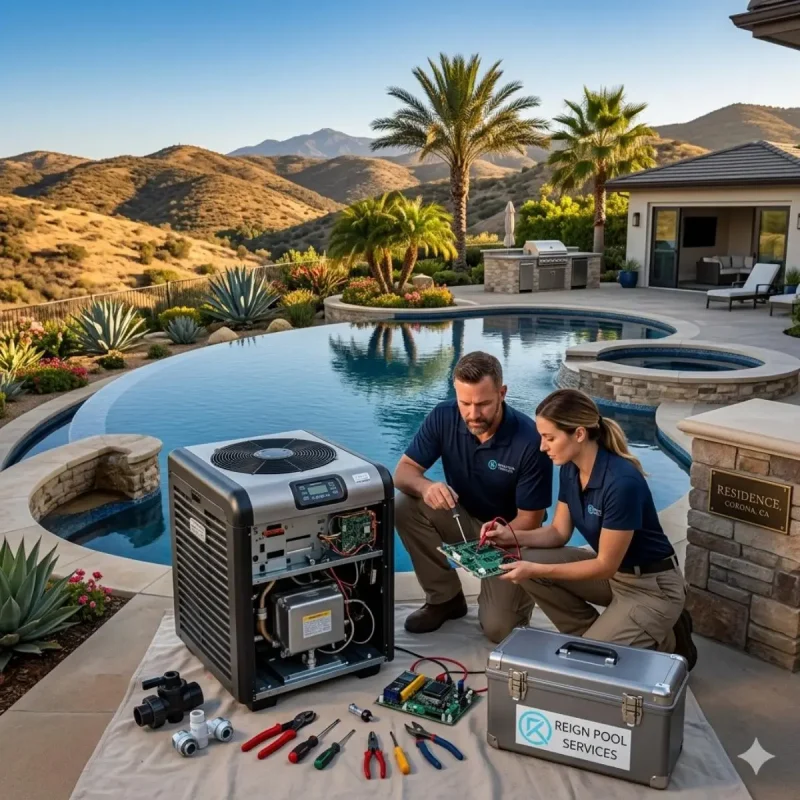
Need pool heater repair? Schedule your free quote from Reign Pool Services
We Are Experts With:




Pool Heater Repair in Corona: Reading the Symptoms
A gas pool heater is a burner tray under a copper or cupronickel heat exchanger. A chain of safety switches all have to agree before the gas valve opens. Pressure switch, high limit, flame sensor, thermostat, and the control board each get a vote. When the heater will not run, one of them is saying no. The job is finding which one and why.
Heater will not ignite
First we check the simple things, in the order the manual lists them. Is the switch on and the thermostat set above the water temperature? Is the pump running with enough flow to close the pressure switch? Is the gas valve open at the heater and at the meter? Are all the plumbing and filter valves open and any bypass set right? Those five checks solve a surprising share of no-heat calls. After that it is the igniter, the flame sensor, the gas valve, or the board. We test each one rather than swapping all four.
Fires, then shuts off
A heater that lights and dies within a minute or two is almost always a flow problem. The pressure switch senses low flow and shuts the gas off to protect the exchanger. A dirty filter, a full pump basket, a pump running on low speed, or a scaled exchanger will all do it. Before we touch a heater part, we read the filter pressure and confirm the pump is moving water. Many “heater repairs” in Corona end as a filter cleaning.
Runs but never reaches temperature
If the burner is lit and the water stays cool, there are three suspects. The heater is undersized, the pool is losing heat faster than it gains it, or the exchanger is scaled inside. A pool loses most of its heat off the surface. An uncovered pool on a windy Corona night can give back half of what the heater put in. We check the temperature rise across the heater first. A healthy gas heater shows a clear rise between inlet and outlet. A small rise with a hot exhaust points to scale in the exchanger.
Error codes
Modern Pentair, Raypak, Hayward, and Jandy heaters show a code for the switch that opened. A flow or pressure code points to the plumbing. A high-limit code points to overheating, usually from scale or low flow. An ignition-failure code points to the igniter, sensor, or gas supply. We read the code, then verify it, because a bad sensor can throw a code for a problem that is not there.
Short cycling and odd noises
A heater that turns on and off every few minutes is usually fighting its own thermostat, a sticking pressure switch, or low flow. Rumbling or kettling from the exchanger is water boiling inside scaled tubes. Soot on the burner tray or a yellow lazy flame means poor combustion and is a safety issue, not a nuisance.
What Our Pool Heater Repair Service Includes
Inspection and flow check
We look over the heater for corrosion, debris, rodent nests, and soot. Then we confirm the basics: power, gas, water flow, and filter pressure. Low flow is the most common reason a heater shuts down, so we rule it out before we spend your money on parts.
Component testing
Igniter, flame sensor, pressure switch, high-limit switch, thermistor, gas valve, blower, and control board. We test each with a meter against the manufacturer’s values. On heat pumps we check the capacitor, contactor, sensors, coil condition, and airflow.
Heat exchanger service
When the exchanger is scaled we tell you how far gone it is. Light scale flushes out. Heavy scale on an older unit usually means the exchanger is near the end. Exchanger replacement costs enough that a new heater is often the better buy. You get both numbers.
Combustion and safety check
On gas heaters we check the flame, the venting, and the clearances. Propane is heavier than air and pools in the burner tray if it does not light. So a propane heater with an ignition fault is a safety job first and a comfort job second.
Repair, test, and set the controls
After the repair we run the heater through a full cycle: ignition, temperature rise, cycling, and safety shutoffs. On a pool and spa combo we confirm the valves switch cleanly and the spa reaches temperature. If the heater runs on a timer, we confirm the fireman switch shuts the heater off before the pump stops. That way the exchanger never sits in hot, still water.
Heater Types We Repair
Natural gas heaters are the most common unit in Corona and the fastest to heat. Propane heaters work the same way with different pressure and orifices. Heat pumps pull heat out of the air and are cheaper to run in our mild weather, but they heat slowly and lose output on cold nights. Electric resistance heaters show up on spas and small bodies of water, and their elements corrode in hard water. Pool and spa combo systems share one heater between two bodies. Most of their problems live in the valves and automation rather than the heater itself. We repair all of them, on Pentair, Raypak, Hayward, and Jandy equipment, plus most other major brands.
Repair or Replace the Heater?
Repair it when the heater is under ten years old and the fault is one part: an igniter, a sensor, a switch, a board. Replace it when the heat exchanger has failed, the parts are no longer made, or the repair costs more than half of a new unit. A heater that has needed two repairs in one season is telling you something too. We give you the repair price and the replacement price side by side so the decision is yours and not ours.
Why Corona's Hard Water Kills Heaters Early
Calcium is less soluble in hot water, so the exchanger scales before the tile or the salt cell does. Scale insulates the tubes, so the burner runs longer for the same rise, the exhaust gets hotter, and the high limit starts tripping. Flow drops, the pressure switch opens, and you get the fires-then-shuts-off call. A gas heater in balanced water lasts eight to twelve years. In Corona water with the chemistry left to drift, six or seven is common.
The fix is upstream of the heater. Keeping calcium hardness, pH, and alkalinity in range on weekly pool service slows scale on every hot surface at once. The CDC’s healthy swimming guidance covers the ranges we hold.
Gas Heater or Heat Pump for a Corona Pool?
Gas heats fast and is the right choice for a spa or for heating on demand for a weekend. A heat pump costs less to run and lasts longer, but it moves heat slowly and struggles on cold nights. So it suits a pool you keep warm all season rather than one you heat for Saturday. If your current heater is at the end of its life, this is the moment to ask which one fits how you actually use the pool. We will size either one to the pool rather than selling the biggest box on the truck.
Spa Heaters and Pool and Spa Combos
Spa heating is where most Corona heater complaints start, because a spa is the one thing people expect to be warm tonight. A standalone hot tub has its own small electric heater, and its element is the first thing hard water attacks. On a pool and spa combo, the spa heats through the main gas heater, and the valves have to turn the right way before any heat reaches it. A spa that will not warm up is just as often a stuck valve actuator or an automation setting as a heater fault. We check the whole path from pump to spa before we quote a heater part. If the problem turns out to be the spa’s own pump, jets, or controls, our spa repair team picks it up.
Keeping the Heater Alive Between Repairs
Three habits add years to a Corona heater. Keep the chemistry balanced so calcium stays in the water instead of on the exchanger. Keep the filter clean so the pressure switch never has a reason to open. And keep the heater cabinet clear of leaves, dust, and nests so the burner gets air and the vents stay open. A heater that runs on balanced water and clean filters has very little to go wrong, which is why most of our heater customers are also on weekly service.
How a Pool Heater Repair Call Works
Call or send the form with the symptom and the error code if there is one. We come out, check flow and filter pressure first, test the heater, and give you the price before the work starts. We finish most repairs on the first visit when the part is one we carry. You do not need to be home if we can reach the pad and the gas valve.
Why Corona Homeowners Call Reign for Heater Repair
We are based in Corona and we repair heaters that run on the same hard water as our own. Every call gets a flow check before a parts quote. Every gas heater gets a combustion and safety check. And you hear repair and replacement side by side. Call (951) 501-2227 or request a free quote.
Pool Heater Repair in Corona: Frequently Asked Questions
Quick answers from the crew.
Cost, lifespan, and repair vs. replace
It depends on the part. An igniter, flame sensor, pressure switch, or thermistor is a small job. A gas valve or control board is a mid-sized one. A heat exchanger is the largest and often costs enough that a new heater makes more sense. We diagnose first and quote before any work.
Usually. Igniters, sensors, switches, boards, gas valves, and blowers are all serviceable parts. The heat exchanger is the one part where repair gets close to replacement cost, so a failed exchanger on an older heater usually means a new unit.
Eight to twelve years for a gas heater in balanced water, ten to fifteen for a heat pump. Corona's hard water can cut a gas heater to six or seven years if the chemistry drifts, because scale builds inside the exchanger.
Repair it if it is under ten years old and the fault is one part. Replace it if the exchanger has failed, parts are discontinued, or the repair costs more than half of a new unit. We give you both prices side by side.
Gas heats fast and suits spas and weekend heating. A heat pump runs cheaper and lasts longer but heats slowly and loses output on cold nights. Pick by how often you heat, not by the sticker price.
Symptoms and causes
Start with the switch, the thermostat setting, the gas valve, and whether the pump is moving enough water to close the pressure switch. After that it is the igniter, flame sensor, gas valve, or control board. We test each one rather than guessing.
Almost always low flow. A dirty filter, a full basket, a pump on low speed, or a scaled heat exchanger opens the pressure switch and the heater shuts down to protect itself. We check filter pressure before touching the heater.
The burner may be lit but the exchanger is scaled, the heater is undersized, or the pool is losing heat faster than it gains it. An uncovered pool on a windy night can lose half of the heat you paid for. We measure the temperature rise across the heater to tell which.
Each code names the safety switch that opened. Flow or pressure codes point to the plumbing and filter. High-limit codes point to overheating from scale or low flow. Ignition codes point to the igniter, sensor, or gas supply. We confirm the code with a meter before replacing anything.
Yes. Calcium drops out of hot water onto the heat exchanger first. Scale cuts flow, overheats the tubes, and trips the safety switches. Keeping calcium hardness and pH in range on weekly service is the only real prevention.