
Pool Light Installation in Corona, CA
Pool light installation and replacement: LED and color-changing underwater lights fitted to the existing niche, sealed, GFCI-protected, bonded, and tied into your automation.

Schedule Service!
Expert Pool Light Installation and Replacement for Corona Pools
In Corona you swim after dark for half the year. A good underwater light is what makes that safe.
Summer evenings in Corona run late and warm, and the pool is the center of them. A pool with no working light after sunset is a hazard. Steps you cannot see, a deep end that disappears, and kids in water nobody can watch. A pool with a dim, yellow halogen light is not much better. A modern LED pool light fixes both, draws a fraction of the power, and lasts for years. The color-changing versions turn the pool into the best part of the yard at night.
The underwater light is also the one piece of pool equipment where a shortcut can hurt someone. The fixture sits in the water with people in it. It has to be the right voltage for the wiring that feeds it, protected by a GFCI, and bonded to the rest of the pool’s metal. It has to stay sealed so water never reaches the lamp. Most of the pool light calls we get in Corona are the same three. A dead fixture, a flooded lens, or a breaker that trips every time the light comes on. Each one is a replacement done to code rather than a bulb swap.
Our pool light installation service covers LED and color-changing lights in the existing niche, and pool and spa lights that run together or separately. It also covers transformers, GFCI breakers, and the automation that runs the show. We install Pentair, Hayward, and Jandy lights and make them work with the controller you already have. Call (951) 501-2227 or request a free quote.
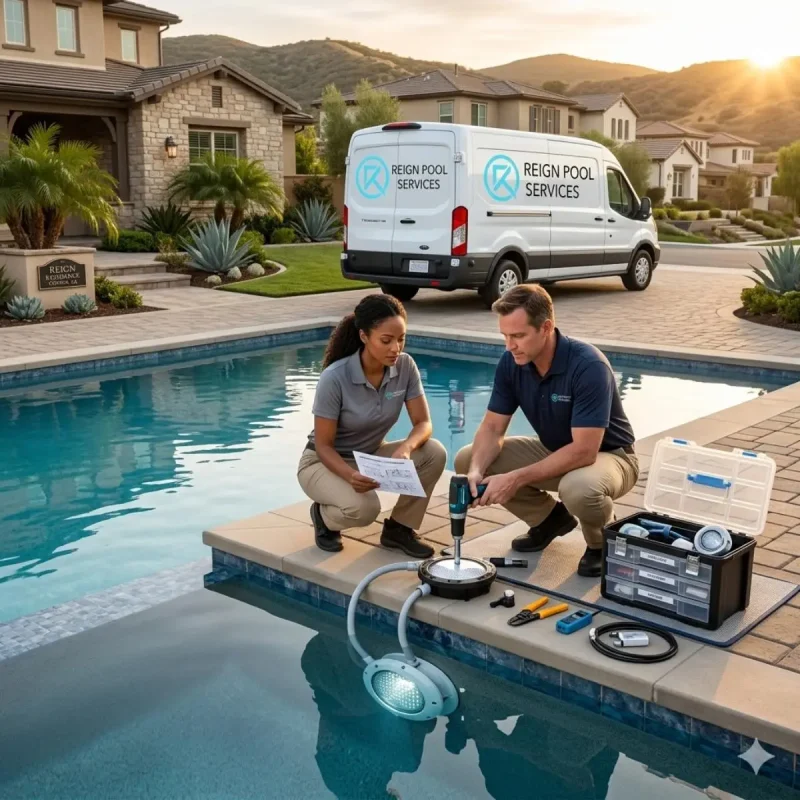
Need a pool light installed or replaced? Schedule your free quote from Reign Pool Services
We Are Experts With:




Pool Light Installation in Corona: LED, Color, and Why Halogen Is Done
The 300 and 500 watt incandescent and halogen lights that lit most Corona pools for thirty years are on their way out. They run hot and burn out every season or two. The heat cooks the lens gasket until the fixture floods. An LED pool light uses a small fraction of that power for brighter, whiter light. It runs cool enough that the gasket lasts, and the LEDs are rated for tens of thousands of hours. On a pool that lights up most summer nights, the LED pays back the price difference in a couple of seasons.
White LED
A fixed white LED is the simplest upgrade. It drops into the same niche as the old light, draws far less power, and gives cleaner light across the whole pool. Most owners who want a safe, bright pool and nothing more choose this.
Color-changing LED
Color-changing lights cycle through fixed colors and light shows from a switch, a remote, or your automation app. Pentair IntelliBrite, Hayward ColorLogic, and Jandy WaterColors are the three we install most. Each pairs with its own brand’s controller. If the pool and spa both have lights, we match them so the colors sync.
Spa and water feature lights
Spa lights are smaller and sit in their own niche. Many combos run one controller for both so the spa and pool change color together. Lights for sheer descents, bubblers, and waterfalls run on the same low-voltage circuit and get the same GFCI and bonding treatment.
12 Volt or 120 Volt: Getting the Voltage Right
Pool lights run on one of two systems. A 120 volt light runs straight from the breaker through a GFCI and a junction box above the water line. A 12 volt light runs through a pool-rated transformer that steps the power down before it reaches the fixture. Both are legal when installed to the electrical code. Both need GFCI protection when the fixture runs above 15 volts, and both need bonding. The new light has to match the system already in the ground. Otherwise the transformer and wiring have to change with it. We check which one you have before we quote. A 12 volt fixture on a 120 volt circuit lasts about a second.
Safety First: GFCI, Bonding, and the Niche
A ground fault circuit interrupter watches the current going out and coming back on the light circuit. The Consumer Product Safety Commission has warned about underwater light electrocutions for decades, and the GFCI is the fix. When they differ by about 5 milliamps, current is leaking somewhere it should not. The GFCI opens the circuit in a fraction of a second. Older Corona pools, especially those built before the 1980s, sometimes have no GFCI on the light circuit at all. We add one on every light we install.
Bonding ties every piece of metal around the pool to the same electrical potential with a solid copper wire. That means the light niche, the rebar in the shell, the ladder, the pump motor, and the heater. When everything is at the same potential there is nothing for current to flow through, which is the whole point. We check the bonding lug on the niche and the junction box before the new light goes in. A light with no bond is a light we will not install.
We inspect the niche itself for a cracked housing, a corroded bonding lug, or water in the conduit. Water in the conduit is why some pool lights trip the breaker. We clear and seal it before power comes back.
What Our Pool Light Installation Includes
Inspection and diagnosis
We check the existing fixture, the niche, the cord and conduit, the junction box, the transformer if there is one, and the GFCI. If the light is out, we tell you which it is before we quote anything: a bulb, a flooded fixture, a bad GFCI, a dead transformer, or wet conduit.
Fixture selection
White or color-changing LED from Pentair, Hayward, or Jandy, matched to your voltage system and your automation. We explain the options and quote the whole job.
Installation in the existing niche
Most replacements use the niche and conduit already in the wall. We pull the old fixture up onto the deck and feed the new cord through the conduit to the junction box. Then we make the connections, seat the new fixture with a fresh gasket, and tighten it down. The pool stays full.
Electrical to code
GFCI protection on the circuit, a transformer where the fixture calls for one, correct wire size, and a verified bond at the niche and the box. If the junction box sits too low or the wiring is undersized, we tell you before the work starts.
Automation and controls
We connect the light to Pentair, Hayward, or Jandy automation so it comes on at dusk, runs a schedule, and answers your phone. Mixed brands sometimes need a relay or an adapter, and we sort that out at the quote.
Test and seal check
We run the light through every mode, confirm the GFCI trips when it should, and check the fixture for bubbles that would mean a bad seal. Then we show you the controls.
Pool Light Repair or Replacement?
A pool light that is out is not always dead. A tripped GFCI, a failed transformer, or a burned bulb in an older fixture are repairs. A flooded fixture, a cracked lens, a corroded cord, or an LED that has lost its drivers is a replacement. Sealed LED fixtures do not get rebuilt. In Corona we see more replacements than repairs. The sun and heat age the above-water parts, and the jump from halogen to LED is worth making when the old light fails anyway. We tell you which you have on the first visit.
Replacing a Pool Light Without Draining the Pool
Almost every pool light replacement in Corona happens with the pool full. A single screw holds the fixture in the niche. The cord is long enough to bring the light up onto the deck, and the new fixture goes back the same way. Draining comes into it only in three cases. The niche itself is cracked, the conduit has failed and needs replacing through the wall, or a new niche is going into a pool that never had a light. Those are bigger jobs and we quote them as such.
Pool Light Repair in Corona
Not every dark pool needs a new fixture, and a pool light repair call starts the same way as an installation: at the breaker, the GFCI, and the junction box. A GFCI that has tripped and will not reset points to a fault in the fixture or the conduit. A GFCI that resets and holds with the light unplugged points to the fixture. A transformer with power in and nothing out is a transformer. On older halogen fixtures a burned bulb and a new gasket is still a repair worth doing if the housing is sound. We carry common gaskets, bulbs, and GFCI breakers, so a true repair usually finishes in one trip. When the fixture is flooded or the LED has failed, repair stops making sense and we quote the replacement on the spot.
Light Brands We Install
Pentair IntelliBrite and Amerlite, Hayward ColorLogic and Universal CrystaLogic, and Jandy WaterColors and White LED cover most of what we put in Corona pools. Each brand’s color lights sync with its own automation. If you have no automation and no plans for it, a standalone color light with a switch-based color change keeps it simple.
Why Corona Pools Go Through Lights
Heat and sun do most of the damage. The junction box and transformer sit in full sun on the pad, and the deck around the niche bakes all afternoon. Halogen lights add their own heat from the inside. Both age the gaskets, and a tired gasket is how water gets into a fixture. Corona’s hard water also leaves a calcium film on the lens that dims the light and hides the start of a leak. Weekly pool service includes a look at the light when the tech brushes the wall. A flooded lens caught early is a fixture swap rather than a conduit job.
How a Pool Light Installation Works
Call or send the form with what the light is doing and what you want it to do. We come out, check the niche, the wiring, the GFCI, and the bond, and quote the fixture and the whole job. We finish most pool light installations in one visit, with the pool full and swimmable when we leave. New wiring, a transformer, or a permit adds time.
Why Corona Homeowners Choose Reign for Pool Lights
We are based in Corona and we treat the pool light as a safety item. Every install gets GFCI protection, a verified bond, a fresh gasket, and a test in every mode before we leave. You get white and color options priced side by side, and the light connected to the automation you already own. Call (951) 501-2227 or request a free quote.
Pool Light Installation in Corona: Frequently Asked Questions
Quick answers from the crew.
Cost, type, and draining
It depends on the fixture, on whether we can reuse the existing niche and conduit, and on whether the circuit needs a GFCI or transformer. A like-for-like LED swap in a good niche is the simplest job. We quote the fixture and the whole job before we start.
Yes, and it is the usual reason for a pool light replacement in Corona. LED fixtures fit the same niche and draw a fraction of the power. They run cooler so the gasket lasts, and they give brighter, whiter light. Color-changing LED is the same swap with a different fixture.
No. The fixture comes up onto the deck on its cord, the new one goes back into the same niche, and the pool stays full. Draining only comes up when the niche or the conduit itself needs replacing.
Sealed LED fixtures carry ratings in the tens of thousands of hours. On a Corona pool that means many years of summer nights. The gasket and the above-water wiring usually age before the LEDs do.
White is simpler and cheaper, and it is all most pools need for safety. Color-changing lights earn their price when the pool is part of how you entertain. They run from a remote or your automation. If the spa has a light too, match them.
Safety, wiring, and brands
Current is leaking to ground, usually from water inside the fixture or in the conduit, or a failing transformer. A GFCI that trips is doing its job. We find the fault and fix it rather than resetting the breaker. Never swim with a light that trips.
It matters for the fixture you buy. A 12 volt light runs through a transformer, a 120 volt light runs straight from a GFCI-protected circuit. Both are legal to code. We check which system you have so the new light matches it.
Yes. The electrical code requires GFCI protection on underwater lights running above 15 volts. It also requires bonding of the niche and nearby metal. Older Corona pools often lack one or both. We add the GFCI and verify the bond on every install.
Usually. Most LED fixtures fit the standard niches on Corona pools and the new cord pulls through the existing conduit. If the niche is cracked, the conduit holds water, or the junction box sits too low, you hear it before the quote.
All three make good LED and color lights. The right one usually matches the automation on your pad, since each brand's color light syncs with its own controller. Without automation, any of the three with a switch-based color change works well.