
Pool Pump Repair in Corona, CA
Pool pump repair for pumps that hum, grind, leak, lose prime, or trip the breaker. Diagnosed on the pad, quoted before the work, usually fixed on the first trip.

Schedule Service!
Expert Pool Pump Repair for Corona Pools
When the pump stops, the pool stops. In a Corona summer that gives you about three days.
The pump is the one piece of equipment every other piece depends on. It pulls water through the skimmer, pushes it through the filter and the heater, and sends it back clean. When it fails, the filter and the chlorinator do nothing and the water starts to turn. In July a still Corona pool goes green within days, so a pump problem should not wait for the weekend.
Corona is hard on pumps. The swim season runs from April into October, so the pump logs more hours in a year than a coastal pump logs in two. The water is heavy with calcium, which scales the shaft seal and shortens its life. The pad sits in full sun, and a motor that runs hot all afternoon loses a little insulation life every summer. Then the Santa Ana winds fill the baskets with grit and the pump works against a restriction.
Our pool pump repair service starts with a proper diagnosis at the pad, because a humming pump and a grinding pump are different faults with different fixes. We carry the common parts for Pentair, Hayward, and Jandy, so most repairs happen on the first visit, and you get the price before we open anything. If the pump is past saving, we say so and quote a pool pump installation in the same visit. Call (951) 501-2227 or request a free quote.
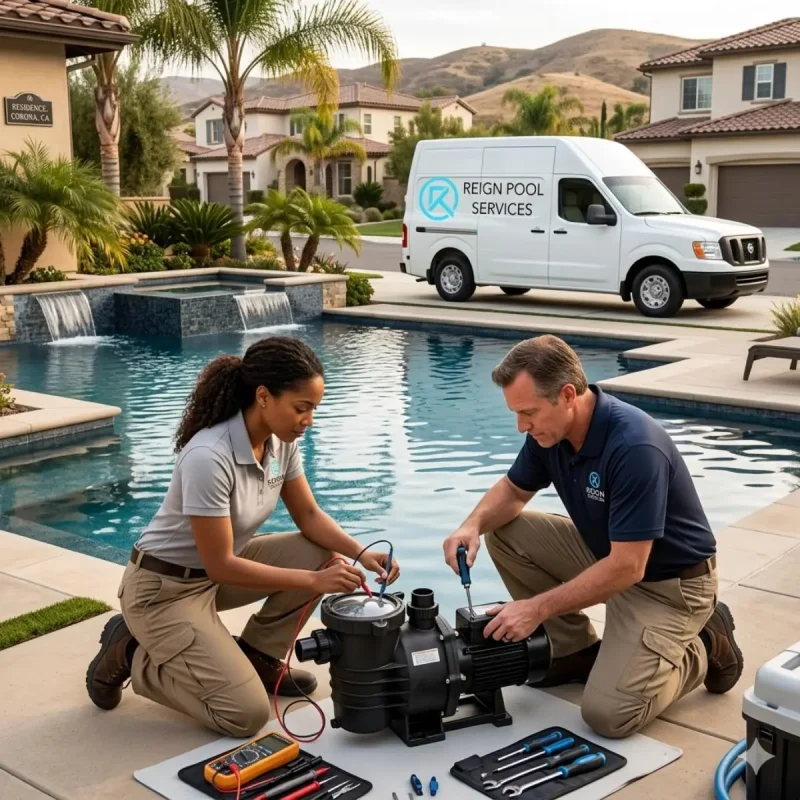
Need pool pump repair? Schedule your free quote from Reign Pool Services
We Are Experts With:




Pool Pump Repair in Corona: What the Pump Is Telling You
A pool pump is a centrifugal pump. A motor spins an impeller, the impeller throws water outward, and the housing turns that spin into flow. Most of what goes wrong lives in five parts: the motor, the capacitor, the bearings, the shaft seal, and the impeller. Each one fails in a way you can hear or see. Here is how we read the symptoms.
Humming but not starting
A pump that hums and does nothing has power but cannot spin. On a single-speed or two-speed pump the usual cause is a failed start capacitor. The motor needs that jolt to get moving, and without it the motor sits there humming and heating. Seized bearings or a debris-jammed impeller cause the same symptom. We turn the shaft by hand first. If it is stiff, the motor is the problem. If it spins free, the capacitor is. Variable-speed pumps do not use a start capacitor, so a hum on one of those points to the drive or a blocked impeller.
Grinding, screeching, or screaming
That metallic noise is the motor bearings. They are usually failing because the shaft seal leaked and let water into the motor. A pump that screams should be shut off, because bearings that seize can score the shaft and turn a bearing job into a motor replacement. On a newer motor we replace the bearings and the seal. On an older one, a new motor is often the better buy.
Leaking at the seal plate
Water dripping from the joint between the motor and the wet end means the mechanical shaft seal has failed. Corona’s calcium is the usual reason. Scale builds on the seal faces and they stop sealing. A seal is a small part and a short job, as long as we get to it before the water reaches the bearings. We replace the seal and check the housing O-ring and the drain plugs at the same time.
Losing prime or air in the pump basket
Air bubbles in the pump lid, bubbles at the returns, or a pump that cannot pull water means air is getting into the suction side. The usual sources are a dry or cracked lid O-ring, a loose union, a worn drain plug, a valve stem, a low water level, or a crack in the suction pipe. A self-priming pool pump can handle some air and re-prime itself. When it cannot, the leak is bigger than the pump can clear. We find it with a pressure test rather than guessing.
Tripping the breaker
A pump that trips the breaker or the GFCI the moment it starts has an electrical fault: a jammed impeller overloading the motor, moisture in the motor or the junction box, damaged wiring, or a shorted winding. Resetting it over and over is how a small fault becomes a dead motor. Leave it off and call. A pump that runs for a while and then trips is usually the thermal overload doing its job because the motor is overheating.
Weak flow and cavitation
A pump that sounds different, rattles, or vibrates while the returns go weak is usually cavitating. The impeller cannot get enough water. The causes are almost always on the suction side: a full skimmer basket, a full pump basket, a partially closed valve, or an air leak. Cavitation damages the impeller and the seal if it runs long enough. A dirty filter causes weak flow too, but with high pressure on the gauge instead of a noisy pump.
What Our Pool Pump Repair Service Includes
Every repair call follows the same order, because the order is how you avoid replacing parts that were not broken.
Diagnosis at the pad
We check the voltage at the motor terminals, the breaker, the timer or automation, and the capacitor. We turn the shaft, look for water in the motor, and read the vacuum and pressure gauges to see whether the problem is the pump or the plumbing around it. Most faults show themselves in ten minutes.
Motor and capacitor repairs
Capacitors, bearings, and thermal overloads on single-speed and two-speed motors. A replacement motor has to match the horsepower and service factor of the original, because the impeller only works with that rating. A bigger motor is not an upgrade. It overloads the plumbing and increases suction at the drain.
Seals, O-rings, and leaks
Mechanical shaft seals, housing O-rings, lid O-rings, unions, drain plugs, and cracked housings. We fix the actual source of the leak rather than tightening everything and hoping.
Impeller, diffuser, and suction problems
Clogged or worn impellers, cracked diffusers, and air leaks on the suction side. Impeller wear often shows up first as a slow drop in filter pressure at the same pump speed.
Variable-speed drives and programming
Drive faults, error codes, overheating, and schedule problems on Pentair, Hayward, and Jandy variable-speed pumps. On many of these the motor and drive are one unit, so a failed drive sometimes makes a new pump the cheaper repair. We tell you which before we quote.
Startup and check
After the repair we prime the pump, bleed the filter, confirm the flow at the returns, and record the clean pressure reading. That number is the baseline for the next filter cleaning. Then we check that the timer or automation is running the schedule it should, because a repaired pump on a bad schedule is still a pool that turns green. On a variable-speed pump we also confirm the low-speed setting moves enough water to turn the pool over.
Repair the Pump or Replace It?
Most pump calls are a repair. A capacitor, a seal, or a set of bearings is a small job on a pump with years left. Replacement makes sense in three cases. The repair costs more than half of a new pump. The housing is cracked or the pump has failed more than once this season. Or it is a single-speed pump with a dead motor.
That last one matters in California. Title 20 rules mean replacement motors of half a horsepower and up have to be variable-speed, and a variable-speed pump run at low speed for filtration uses a fraction of the power of the single-speed pump it replaces. On a ten-year-old single-speed pump with a burned-out motor, the replacement usually wins once you count the electric bill. We lay out both numbers and let you pick.
Pump Brands We Repair
Pentair, Hayward, and Jandy cover most of the pads in Corona, and we carry their common parts on the truck. That includes Pentair WhisperFlo, IntelliFlo, and SuperFlo, Hayward Super Pump, TriStar, and MaxFlo, and Jandy Stealth, FloPro, and the VS series. We also work on Sta-Rite, Waterway, and Speck pumps, and on Century and A.O. Smith motors. Before any motor swap we photograph the nameplate so the replacement matches the voltage, horsepower, and service factor of the original.
Why Corona Wears Out Pumps Faster
Three local conditions shorten pump life here. Heat is the first. A motor is rated for a hot pad, but a motor that runs eight hours a day in full sun loses winding life every summer, and a motor cover without airflow makes it worse. Hard water is the second. Calcium scales the seal faces, and a seal that leaks sends water straight into the bearings. Debris is the third. Wind-blown grit fills the baskets, the pump runs against a restriction, and the suction side pulls air past any seal that is already tired. Weekly pool service catches most of this early, because a full basket, a rising vacuum reading, or a damp seal plate is visible on every visit.
How Fast Does a Pool Turn Green Without a Pump?
In a Corona summer, two to four days. Warm water, full sun, and no circulation let algae take hold quickly, and once the water is green the fix is a green to clean job rather than a pump repair. If the pump dies on a Friday in July, call us that day. If the pool has already turned, we handle both.
How a Pool Pump Repair Call Works
Call or send the form with what the pump is doing. A noise, a leak, bubbles, or an error code all help. We come out, diagnose it, and give you the price before the work starts. You do not need to be home if we can reach the equipment pad. We finish most repairs on the first visit, and the pool is running again before we leave.
Why Corona Homeowners Call Reign for Pump Repair
We are based in Corona and we work on pumps that run in the same heat and the same hard water as ours. Every call gets a diagnosis before a quote, the common parts are on the truck, and you hear the repair and replacement options side by side. Call (951) 501-2227 or request a free quote.
Pool Pump Repair in Corona: Frequently Asked Questions
Quick answers from the crew.
Cost, timing, and repair vs. replace
It depends on the part. A capacitor, a shaft seal, or a lid O-ring is a small job. Bearings and a seal are a mid-sized one. A motor or a full pump is the largest. We diagnose first and give you the price before any work starts, with the replacement option beside it.
Most of them, yes. Capacitors, seals, bearings, impellers, and O-rings are all serviceable parts. We recommend replacement when the repair costs more than half of a new pump, the housing is cracked, or it is an old single-speed pump with a dead motor.
Usually, if the housing, impeller, and diffuser are sound. The new motor has to match the horsepower and service factor of the old one. On older pumps or variable-speed pumps with the drive built into the motor, a whole new pump is often the cheaper route.
Roughly eight to twelve years. Corona's heat and hard water push pumps toward the short end, and a seal leak that runs into the bearings can end a motor early. Weekly service and clean baskets stretch the life.
Tell us what the pump is doing when you call. We move a dead pump in summer to the front of the line, because a still pool turns green in a few days. We carry common parts, so most repairs finish on the first visit.
Symptoms and causes
On a single-speed pump it is almost always the start capacitor, or a motor that has seized. We turn the shaft by hand to tell the two apart. Variable-speed pumps have no start capacitor, so a hum there points to the drive or a jammed impeller.
Grinding or screaming means the motor bearings are failing, usually because a leaking shaft seal let water into the motor. Shut it off. Bearings that seize can score the shaft and turn a bearing job into a motor replacement.
A drip between the motor and the wet end is the mechanical shaft seal, which Corona's calcium wears out early. Leaks at the lid, unions, or drain plugs are O-rings and gaskets. All are small repairs if they are caught before the water reaches the bearings.
Air is getting into the suction side. The usual sources are a dry lid O-ring, a loose union, a worn drain plug, a low water level, or a cracked suction pipe. We find the leak with a pressure test rather than guessing.
A jammed impeller, moisture in the motor, damaged wiring, or a shorted winding. A pump that trips right away should stay off rather than be reset again. One that runs and then trips is usually overheating and shutting down on its thermal overload.