
Pool Heater Installation in Corona, CA
Pool heater installation and replacement: gas heaters and heat pumps sized to your pool, plumbed and connected to code, and tied into your automation.

Schedule Service!
Expert Pool Heater Installation for Corona Pools and Spas
Corona gives you eight warm months. A heater gives you the other four, plus every spa night in between.
Pool water in Corona drops into the 50s and 60s from November through March. It cools fast on windy evenings even in season. Without a heater the pool sits empty a third of the year and the spa is a cold tub. A properly sized heater fixes both. A gas unit brings the spa to temperature in under an hour. The pool holds wherever you want it, so the season stretches into fall and starts again in early spring.
The heater is also the most involved install on the pad. A gas unit needs a gas line that can feed it, clearances that meet code, and venting that works. It also needs enough water flow to keep its safety switches happy. A heat pump needs the right electrical service and room to breathe. Both need sizing from the pool’s surface area and how you use it, not from whatever model was there before. Undersize it and it runs all day and never catches up. Oversize it and you paid for capacity you never use.
Our pool heater installation service covers natural gas and propane heaters, heat pumps, and pool and spa combos. We size the unit and handle the gas or electrical work. We pull the permit when one is needed and connect the heater to your automation. If your current heater has one bad part, our pool heater repair page is the better stop. If it is time for a new one, call (951) 501-2227 or request a free quote.
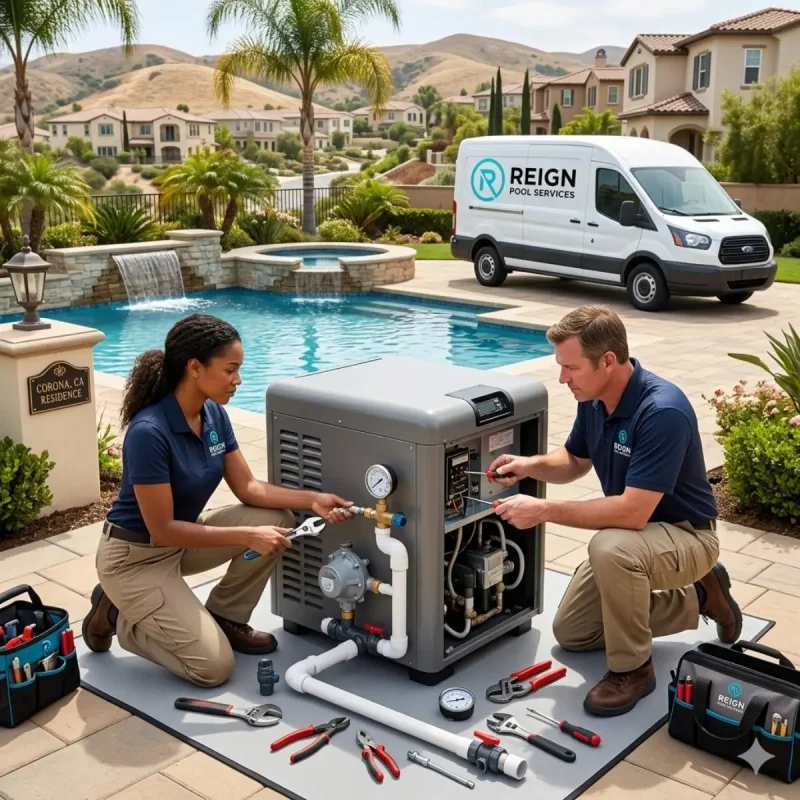
Need a new pool heater? Schedule your free quote from Reign Pool Services
We Are Experts With:




Pool Heater Installation in Corona: Gas, Heat Pump, or Solar
The three ways to heat a pool each fit a different kind of owner. The right choice depends on how you use the water more than on the sticker price.
Gas heaters
Natural gas and propane heaters heat fast and heat on demand. They do not care what the air temperature is. That makes them the right choice for spas and for anyone who wants the pool warm this weekend rather than all month. They cost more to run per hour than a heat pump. So they suit occasional heating better than holding a pool at 85 degrees from October to April. Most Corona homes already have natural gas, which makes a gas heater the simplest install.
Heat pumps
A heat pump pulls heat from the air and moves it into the water. It uses electricity only to run a compressor and a fan. So it delivers several times more heat energy than it consumes. That makes it the cheapest heater to run in Corona’s mild weather, and the right choice for a pool you keep warm all season. The trade is speed. A heat pump raises the pool a degree or two an hour at best. Its output drops on cold nights. It will not warm a spa for tonight.
Solar
Solar panels on the roof heat the pool for the cost of running the pump through them. They add weeks to the season on either end and cost nothing to run once installed. But they only work when the sun is out, and they heat slowly. We can talk through whether solar fits your roof and whether it pairs with a gas or heat pump backup.
Sizing the Heater to Your Pool
Heater sizing starts with a simple equation. The heat needed to raise the pool is the gallons, times 8.33, times the temperature rise you want. The answer is in BTUs. A 20,000 gallon pool raised 10 degrees needs about 1.7 million BTUs. A 400,000 BTU heater at full output delivers that in a little over four hours of burn time, before losses. Spread the same rise over a day and a smaller heater does it.
Surface area matters as much as volume. A pool loses most of its heat off the surface to evaporation and wind. An uncovered pool on a breezy Corona night can lose half of the heat you put in. With a cover, that loss drops to a quarter or less. So we size from the pool’s volume and surface area, the rise you want, and how fast you want it. Wind exposure and whether you will cover the pool go into the math too. Then we pick the heater that gets there without running flat out.
For a pool and spa combo the spa usually drives the size. You want it hot in an hour, and that takes a big burner working on a small volume. For a pool alone with a cover and a heat pump, a smaller unit running longer is the cheaper answer.
What Our Pool Heater Installation Includes
Site assessment
We look at the pad, the gas meter and line size or the electrical panel, and the plumbing. We also check the filter and pump, any automation, and the clearances around the heater location. Gas heaters need a non-combustible level base, set distances from walls and windows, and room for venting and service. A heater near a spa has to sit at least five feet from the spa wall or behind a permanent barrier.
Gas line and meter check
A big gas heater burns a lot of fuel at full fire. If the existing gas line or meter cannot feed it along with the house, the heater starves, short cycles, and soots up. We check the line size and the run from the meter before we quote. If the line needs upsizing or the gas company needs to change the meter, you hear it then.
Electrical for heat pumps
A heat pump needs its own circuit sized for the compressor, a disconnect at the unit, and bonding to the pool’s equipment. We confirm the panel has the capacity before the unit is ordered.
Plumbing and placement
The heater goes downstream of the pump and filter and upstream of any chlorinator or salt cell. That way clean water reaches the exchanger and concentrated chlorine does not. We plumb it with unions and a bypass where it helps. It sits on a level pad with the clearances the manufacturer and the city require.
Controls and the fireman switch
If the pool runs on a timer or automation, the heater gets a fireman switch. That control shuts the burner off before the pump stops. That lets the exchanger cool under flow instead of baking in still water, which is what cracks heat exchangers early. We set the thermostat and connect the heater to Pentair, Hayward, or Jandy automation if you have it. On a combo we set the pool and spa temperatures separately.
Startup and test
We fire the heater, check the flame and the exhaust, and confirm the temperature rise across the exchanger. Then we test the pressure switch and high limit and run the pool and spa modes. Then we walk you through the controls.
Permits and Inspections in Corona
A new gas line, new gas connections, or a new electrical circuit for a heat pump usually needs a permit through the City of Corona Building Division. An inspection follows when the work is done. A straight like-for-like swap on existing connections often does not. Solar pool heating is its own case: the city requires a mechanical permit and a final inspection for rooftop solar pool heaters. We tell you which yours is before the job. When a permit is needed it goes in the quote, and we handle the inspection.
Heat Pump Installation in Corona
Pool heat pump installation has its own checklist. The unit needs open air on the intake and exhaust sides, because it heats the water by pulling warmth out of the air passing through it. Tuck it against a wall or under an overhang and the output drops. It needs a level pad, a condensate path, and a circuit from the panel with the right breaker. The plumbing is the same as a gas heater: after the filter, before the chlorinator, with a bypass if the flow is high. We also set the owner’s expectations, because a heat pump is a set-it-and-hold-it heater. It keeps a pool warm cheaply all season. It will not bring a cold spa up for tonight, which is why many Corona combos pair a heat pump for the pool with a gas heater for the spa.
Replacing an Old Pool Heater
Most heater installations in Corona are replacements. A gas heater here lasts eight to twelve years. It lasts less when the water chemistry has let calcium scale the exchanger. If your heater is past ten years old, takes longer to heat every season, or will not stay lit, replacement usually beats another repair. A leaking or corroded exchanger settles it. Replacement is also the moment to switch fuel, add a heat pump alongside a gas unit, or fix a heater that was never sized right. We inspect the existing unit as part of the quote. You get the repair price next to the replacement price.
Heater Brands We Install
Pentair MasterTemp and UltraTemp, Raypak Digital and heat pumps, Hayward Universal H-Series and HeatPro, and Jandy JXi cover most of what goes onto Corona pads. All four make reliable units with cupronickel exchanger options that hold up better in hard water. We match the brand to the automation already on the pad when there is one. That way the heater and the controller speak the same language.
Why Corona's Hard Water Shapes the Install
Calcium drops out of hot water onto the hottest surface it finds. In a pool that is the heat exchanger. A new heater in Corona starts scaling the day it is installed unless the chemistry is held in range. So we set the heater up to protect itself. A cupronickel exchanger where the budget allows. A fireman switch so it never sits in hot, still water. And a note on your weekly pool service plan to hold calcium hardness and pH where they belong. A heater that runs on balanced water lasts years longer than one that does not.
How a Pool Heater Installation Works
Call or send the form with your pool size, whether you have a spa, and what fuel is available. We come out, measure, check the gas or electrical, and quote the options with the whole job priced. Gas heater installs usually take a day, longer when a gas line or a permit inspection is involved. Heat pumps take about the same. The pool is back in service as soon as the heater is tested.
Why Corona Homeowners Choose Reign for Heater Installation
We are based in Corona and we size heaters to the pool rather than to the shelf. Every install gets the gas or electrical checked before we order the unit. The clearances and venting are done to code, and the heater is connected to your automation. You get gas and heat pump priced side by side so the choice is yours. Call (951) 501-2227 or request a free quote.
Pool Heater Installation in Corona: Frequently Asked Questions
Quick answers from the crew.
Cost, size, and type
It depends on the heater, on whether a gas line or circuit has to be added, and on whether the job needs a permit. A straight swap on existing connections is the simplest job. We quote the whole job, including the unit, the connections, haul-away, and the permit when one is needed.
Gas heats fast and suits spas and weekend heating. A heat pump costs far less to run and suits a pool you keep warm all season. But it heats slowly and loses output on cold nights. Many combo owners run gas for the spa and accept the pool heating slower.
Size from the pool's gallons and surface area, the rise you want, and how fast you want it. Wind exposure and a cover change the answer. A spa drives the size on a combo. We run the numbers and pick a heater that does the job without running flat out.
A gas heater sized to the pool raises it ten degrees in a day or less. It brings a spa up in under an hour. A heat pump raises a pool a degree or two an hour, so the same rise takes a day or two. A cover roughly halves the time either way.
You do not need one, but it is the cheapest heating upgrade there is. Most heat leaves off the surface. An uncovered pool on a windy night can lose half of what the heater added. A cover cuts that loss to a quarter or less and shortens heat-up time.
Gas, electrical, permits, and brands
Often not for a large heater. A 400,000 BTU unit burns a lot of gas at full fire. An undersized line or meter starves it. We check the line size and the run from the meter before quoting and tell you if either needs upsizing.
New gas lines, new gas connections, or a new electrical circuit usually need a permit and inspection. That runs through the City of Corona Building Division. A like-for-like swap on existing connections often does not. We confirm before the job and handle it.
All four make solid heaters. We usually match the heater to the automation already on the pad. For Corona's hard water we choose a cupronickel exchanger when the budget allows. Local parts availability matters more than the badge.
Yes, on a pool and spa combo the main heater serves both through valves that switch the flow. The spa needs the big burner to heat fast, so the spa usually sets the heater size. Automation lets you set separate temperatures for each.
Usually a day for a gas heater on existing connections or a heat pump on a ready circuit. A new gas line, a new electrical circuit, or a permit inspection adds time. The pool is back in service as soon as the heater passes its test.